Leaders, government agencies and businesses all want to see our regions prosper. Workers want to feel safe at work, and families want to know they live in a safe community that provides security and opportunity, for themselves and their children. Despite continued efforts, crime and anti-social behaviour remain significant barriers to the many communities reaching their full potential.
Police and other government agencies are stretched and constrained by the complexities of social issues.
In some areas of the country, private security firms have been contracted to provide an additional layer of security on the streets of towns and cities, yet they are operating blind without access to systems that would assist them in identifying high risk individuals and persons of Interest.
Police and other government agencies are hampered in their ability to effectively police. Existing body worn camera vendors have publically stated that they will never connect to biometric identification, limiting their use to retrospective analysis for convictions and scrutiny of police actions, or potential behaviour modification.
Identification of a person or multiple persons of interest relies solely on human visual ID, which can be flawed and delay decision making capability, especially in larger crowds.
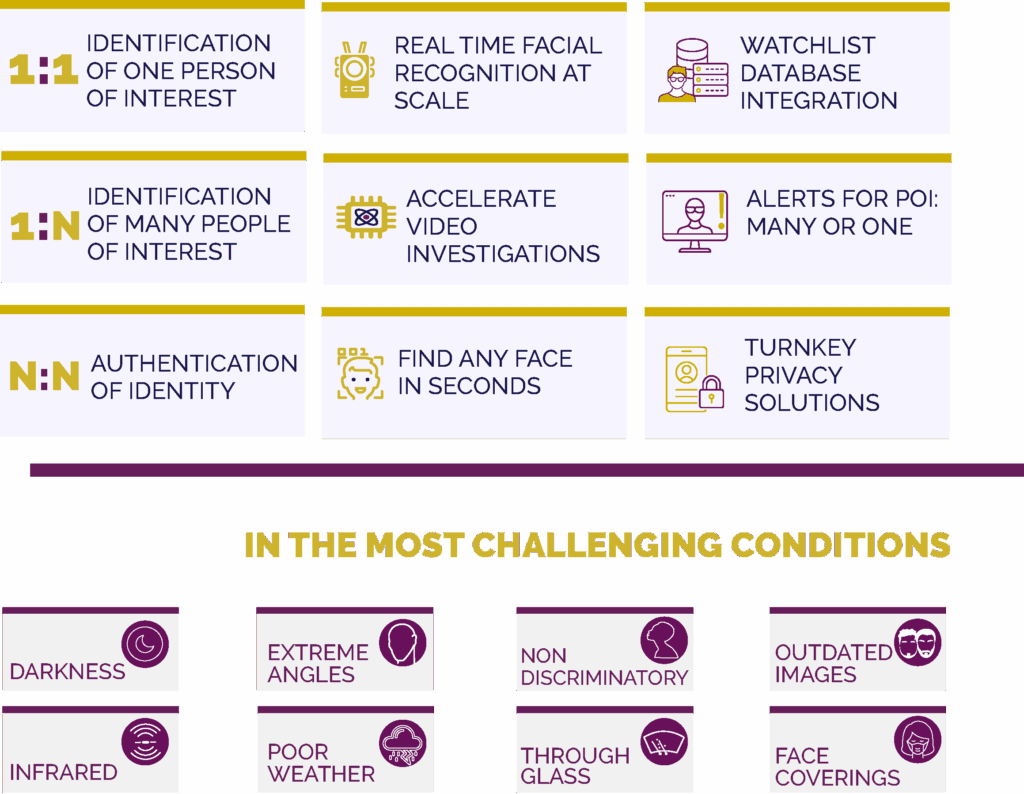
Real-time biometric identification coupled with live-stream capacity in body worn cameras will provide operating personnel with accurate and timely information to determine, with headquarter or management support if required, an effective course of action. Such capability will mean persons of interest can be easily identified, with past history alerts raised instantly. Policing and compliance outcomes are greatly reduced, while the safety of personnel is greatly increased, whether in the field, behind the counter or on the streets.